In this article
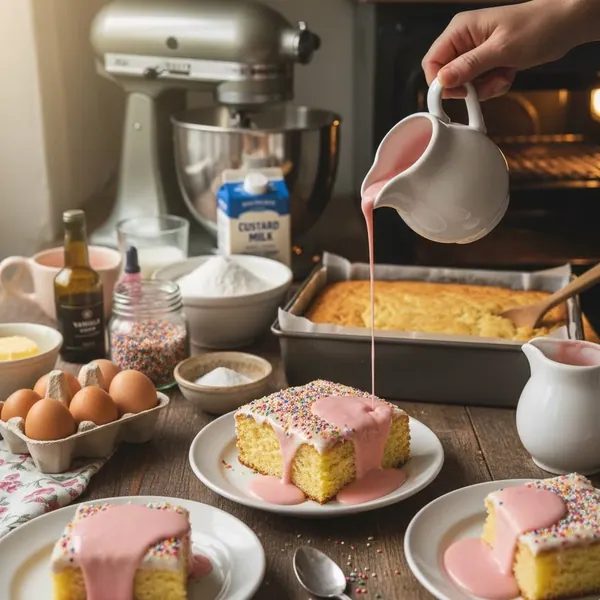
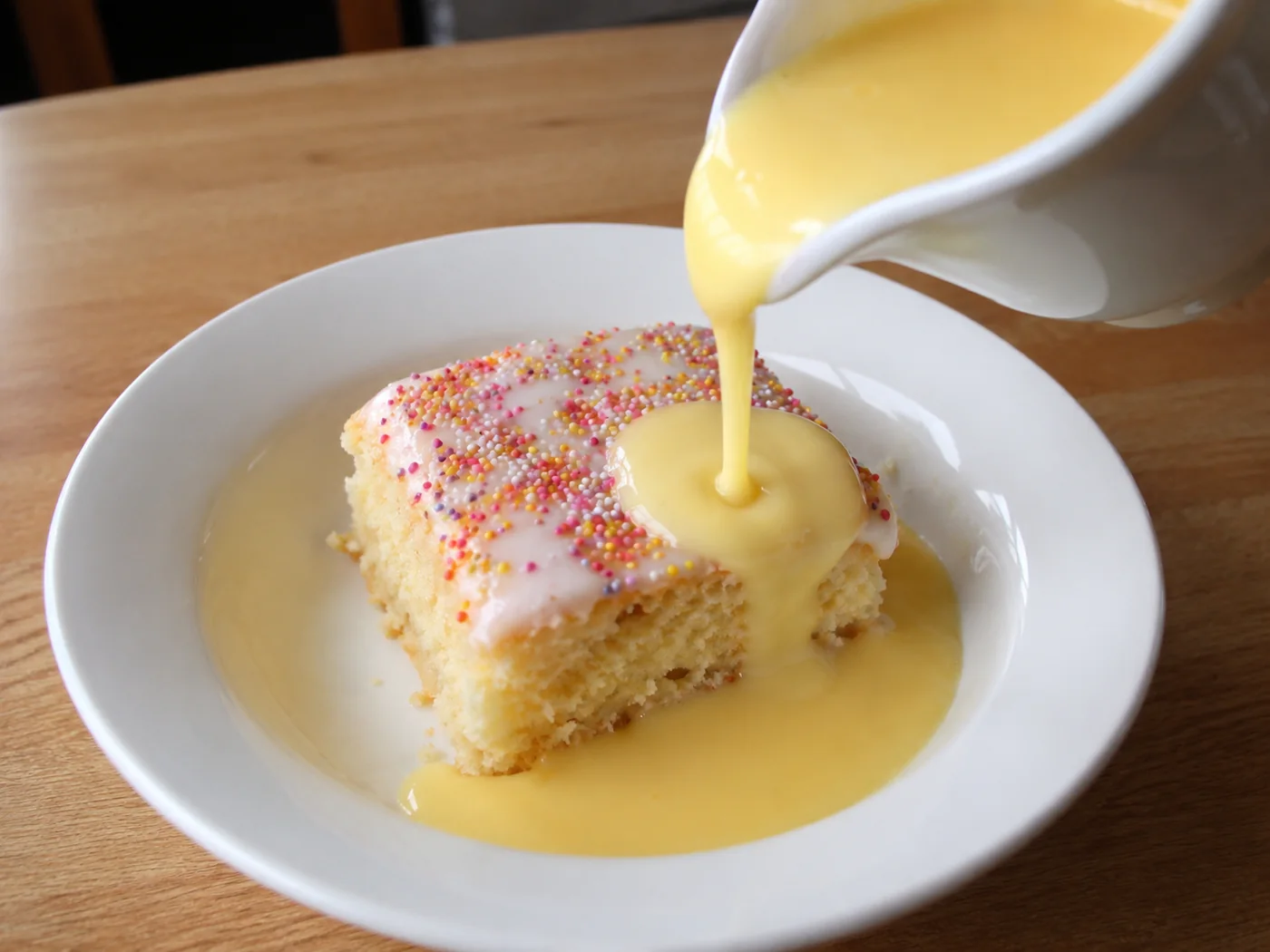
Some puddings need no introduction, just a Formica tray and a dinner hall. School cake – a square of soft vanilla sponge under a layer of white icing and hundreds and thousands, usually sitting in a pool of custard – is one of the most requested nostalgic bakes in Britain, and one of the easiest to get wrong by making it too fancy.
Because the whole point of school cake is that it wasn’t fancy. It was batch-baked in enormous trays by dinner ladies working to a catering-margarine budget, iced with nothing but icing sugar and water, and finished with a flick of sprinkles. Recreate that honestly – right down to the margarine – and one bite puts you straight back on a plastic chair in 1995. Dress it up with buttercream and it stops being school cake altogether.
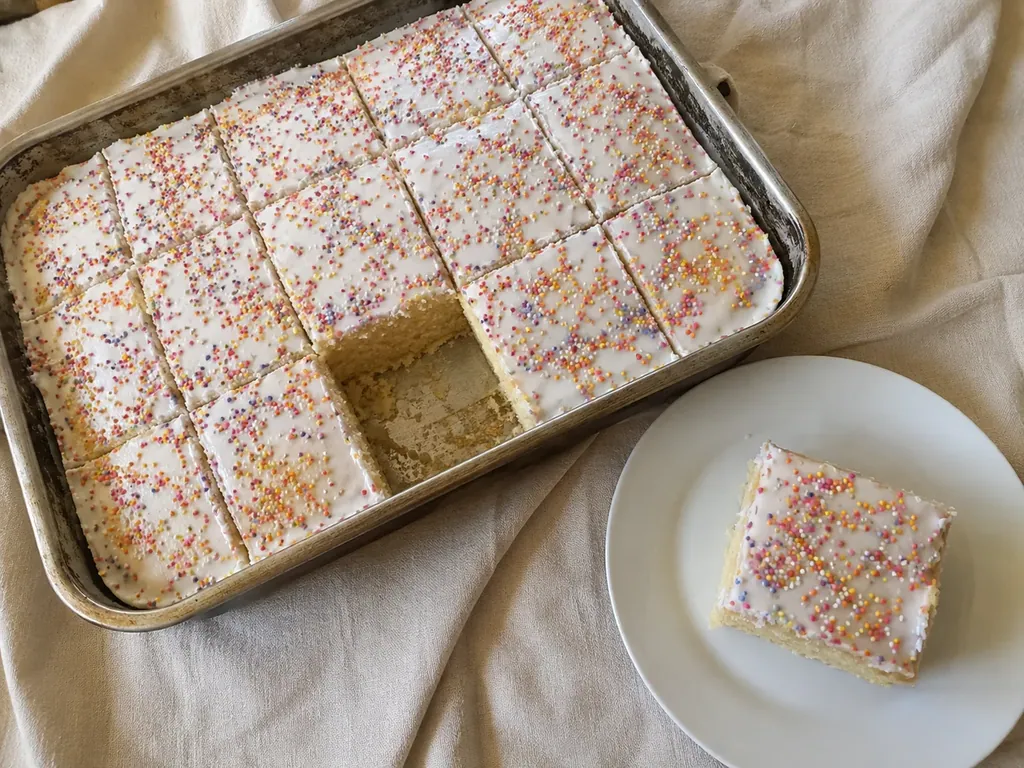
This recipe stays faithful to the dinner-hall original: an equal-weight sponge, thick water icing that sets to a gentle crust, hundreds and thousands, and fifteen proper squares.
What is school cake?
School cake – also called old school cake, school sprinkle cake, sprinkle sponge or school dinner cake – is a plain vanilla sponge baked in a rectangular tray, topped with white glacé icing and hundreds and thousands, and cut into squares. From the 1960s to the late 1990s it was a fixture of British school dinners, served warm-ish with a ladle of custard.
It belongs to a whole family of school-dinner puddings – the cornflake tart, gypsy tart and chocolate concrete among them – that school kitchens could produce by the hundred from cheap cupboard ingredients. That’s why the recipe is so simple, and why it’s so beloved: almost everyone in Britain under sixty ate it every week for years.
Why this recipe works
- Equal weights, like the dinner ladies used. 225g each of fat, sugar and self-raising flour with 4 eggs. School kitchens worked to simple ratios that scaled to trays of a hundred portions – it’s also what makes the sponge forgiving.
- Margarine, not butter – yes, really. The original was made with catering block margarine, and that slightly soft, tender crumb is the taste people remember. A soft baking spread like Stork is the authentic choice; softened butter works and tastes richer, but reads a touch more “Victoria sponge”.
- A splash of milk keeps it moist for days. School cake was baked in the morning and eaten after the shepherd’s pie – it had to hold. The milk loosens the batter so the sponge stays soft rather than tightening as it sits.
- Thick icing, not a drizzle. School cake icing is a proper layer that sets to a thin crust you can dent with a fingernail. That means less water than you think: the icing should fall off the spoon in a slow, heavy ribbon, not pour.
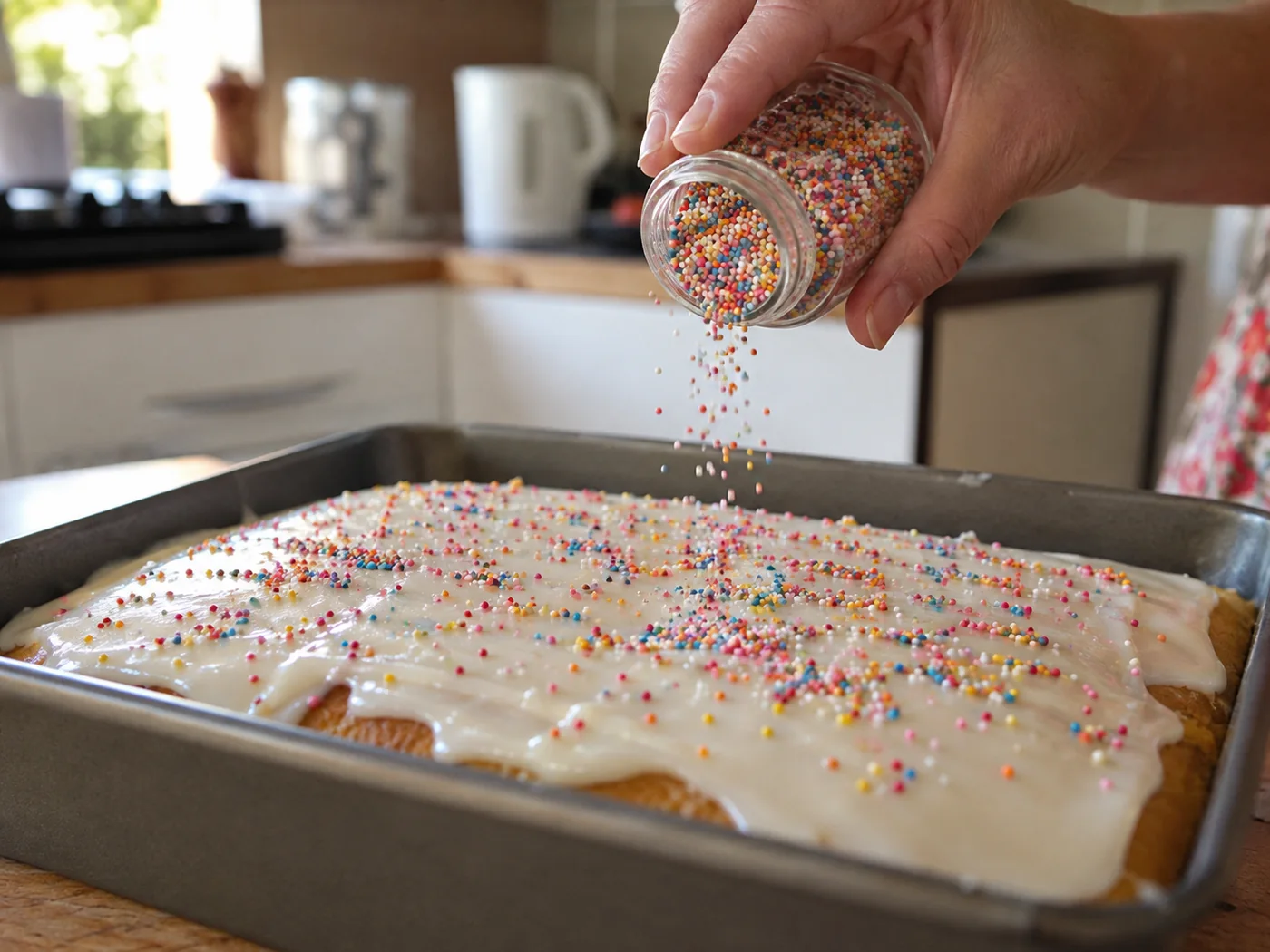
- Cold cake, wet icing, immediate sprinkles. Ice a warm cake and the icing melts in and turns the top gummy; wait too long after icing and the hundreds and thousands bounce off instead of sticking. Cool completely, ice, sprinkle straight away.
Ingredients
For a 20x30cm traybake tin (15 squares):
For the sponge:
- 225g soft baking margarine (such as Stork), or softened unsalted butter
- 225g caster sugar
- 4 medium eggs, at room temperature
- 225g self-raising flour
- 1 teaspoon baking powder
- ¼ teaspoon fine salt
- 2 tablespoons milk
- 1 teaspoon vanilla bean paste (optional – the dinner ladies left it out)
For the icing:
- 300g icing sugar
- 3–4 tablespoons cold water
- Hundreds and thousands, for the top
On the sprinkles: proper hundreds and thousands – the tiny round multicoloured ones – not long strand sprinkles. The strands are for fairy cakes; the little beads are what school cake wore. They’re with the baking decorations in any supermarket.
How to make old school cake
1. Prepare the tin and oven
Heat the oven to 180°C (160°C fan) and line a 20x30cm traybake tin with baking parchment, leaving some hanging over the long sides so you can lift the cake out in one piece later.
2. Cream the margarine and sugar
Beat the margarine and caster sugar together for 3–4 minutes with an electric whisk until pale and fluffy. Don’t rush this – it’s where the sponge gets its lightness.
3. Add the eggs
Beat in the eggs one at a time, mixing well after each. If the mixture starts to look curdled, add a spoonful of the flour and carry on – it will come back together.
4. Fold in the flour
Sift in the self-raising flour, baking powder and salt and fold them in gently with a spatula until no streaks remain. Stir in the milk (and vanilla, if using) to loosen the batter – it should drop reluctantly off the spoon.
5. Bake
Scrape the batter into the tin, level the top and bake for 25–30 minutes, until golden and a skewer poked into the middle comes out clean. Leave to cool in the tin for 10 minutes, then lift out onto a wire rack and – this is important – cool completely before icing.
6. Make the icing
Sift the icing sugar into a bowl and add the water one tablespoon at a time, stirring well between each. Stop when the icing falls off the spoon in a slow, thick ribbon that holds its shape for a moment on the surface – usually just over 3 tablespoons. It always takes less water than seems possible; if it turns runny, rescue it with more icing sugar.
7. Ice and sprinkle
Pour the icing over the cold sponge and spread it right to the edges with the back of a spoon or a palette knife. Scatter the hundreds and thousands over straight away, while the icing is still wet, so they stick.
8. Set and slice
Leave for 30–60 minutes, until the icing has set to a thin crust. Cut into 15 squares with a large sharp knife, wiping the blade between cuts for clean edges.
The custard is not optional
At school, this cake never arrived alone – it came in a shallow bowl with hot custard ladled over it, the icing going slightly melty where they met. If you’re chasing the full memory, make it a pudding: warm each square for 10–15 seconds in the microwave and pour over proper hot custard. (School custard was made from powder, and honestly, for authenticity’s sake, that’s still the right call here.)
Cold, with a cup of tea, a square of school cake is a perfectly respectable traybake. But with custard, it’s a time machine.
Variations from the dinner hall
- Jam and coconut sponge – the same tray sponge spread with red jam and showered in desiccated coconut instead of icing. It had its own devoted following; we have a full jam and coconut school cake recipe.
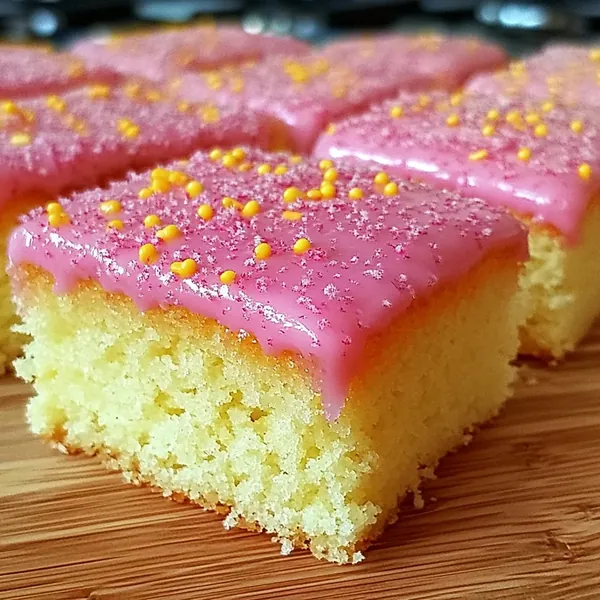
- Tottenham cake – the pink-iced cousin, its icing traditionally coloured with mulberry juice, sold for a penny a square long before it reached school canteens. Our pink icing school sponge is that one.
- Lemon icing – swap a tablespoon of the icing water for lemon juice. Not strictly canon, but very good.
- Smaller batch – halve everything and bake in a 20cm square tin for 20–25 minutes; cuts into 9 squares.
Storage and make-ahead
School cake keeps in an airtight tin for 3–4 days – the icing actually helps seal the sponge and it’s arguably better on day two. Don’t refrigerate it; the fridge dries the crumb and makes the icing weep.
To freeze, freeze the sponge un-iced, wrapped well, for up to 3 months; defrost at room temperature and ice on the day. Iced squares can be frozen at a pinch, but the icing loses its crust and the sprinkles bleed a little as they thaw.
FAQ
Why does school cake taste different from a Victoria sponge? Three things: margarine instead of butter, a slightly denser batch-baked crumb, and that thick layer of plain water icing instead of buttercream and jam. It’s the icing especially – sweet, faintly crisp on top, soft underneath – that makes it taste like school.
Why is my icing runny / soaking into the cake? Either the cake was still warm when you iced it, or the icing had too much water. The sponge must be completely cold, and the icing should ribbon thickly off the spoon – start with 3 tablespoons of water and only add more drop by drop.
Can I use butter instead of margarine? Yes – softened unsalted butter makes a richer, slightly firmer sponge. It’s a very good cake; it’s just a shade less “school”. For the flavour people actually remember, margarine is the authentic choice.
Why didn’t my sprinkles stick? The icing had already started to set. Hundreds and thousands need to land on wet icing, so ice the cake and sprinkle immediately – don’t answer the door in between.
How long does school cake take to bake? 25 to 30 minutes at 180C (160C fan) in a 20x30cm tin. It is done when the top is golden and a skewer pushed into the centre comes out clean. Cooling, icing and setting add about an hour and a half, so allow two and a half hours start to finish.
Do you keep school cake in the fridge? No. The fridge dries the sponge and makes the icing weep. Keep it in an airtight tin at room temperature for 3 to 4 days.
How many calories are in a square of school cake? About 345 calories per square when the tray is cut into 15. Most of that is the sponge; the icing adds around 80.
Can I make school cake with plain flour? Yes. Use 225g plain flour with 3 teaspoons of baking powder instead of the self-raising flour and 1 teaspoon. The crumb is very slightly denser but nobody will notice under the icing.
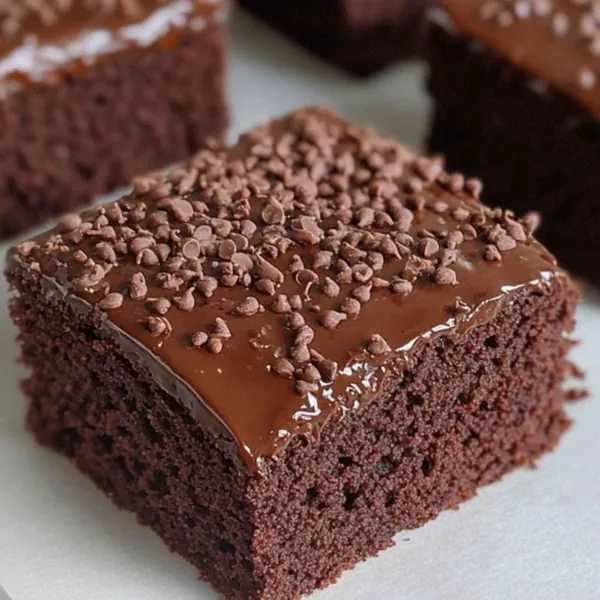
Is there a chocolate school cake? There was, in some schools: the same sponge with 30g of cocoa swapped in for 30g of the flour, iced with the same water icing made with 2 tablespoons of cocoa added to the icing sugar, and finished with the same sprinkles. Our old school chocolate traybake is that recipe.
Can I double it for a crowd? That’s exactly what it was invented for. Double everything into a large roasting tin (roughly 25x38cm), bake for 35–40 minutes, and cut 30 squares – dinner-lady scale.
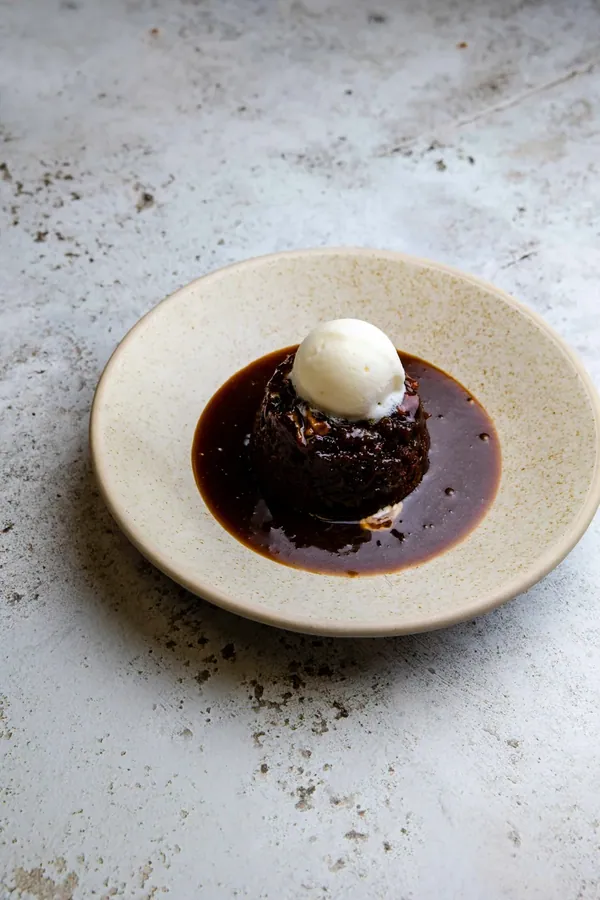
If this one hits the spot, the rest of the school-dinner pudding canon is waiting: butterscotch tart, sticky toffee pudding, and the immortal chocolate concrete with mint custard.
Old School Cake
The classic British old school cake: a soft vanilla sprinkle sponge baked in a 20x30cm tray, topped with thick white icing and hundreds and thousands, cut into 15 squares and served with hot custard - exactly like school dinners.
Ingredients
- 225g soft baking margarine (such as Stork), or softened unsalted butter
- 225g caster sugar
- 4 medium eggs, at room temperature
- 225g self-raising flour
- 1 teaspoon baking powder
- 1/4 teaspoon fine salt
- 2 tablespoons milk
- 1 teaspoon vanilla bean paste (optional)
- 300g icing sugar
- 3-4 tablespoons cold water
- Hundreds and thousands, for the top
Instructions
- Heat the oven to 180C (160C fan) and line a 20x30cm traybake tin with baking parchment, leaving some overhanging the long sides.
- Beat the margarine and caster sugar together for 3-4 minutes until pale and fluffy.
- Beat in the eggs one at a time, mixing well after each. If the mixture curdles, add a spoonful of the flour and carry on.
- Sift in the self-raising flour, baking powder and salt and fold in gently until no streaks remain, then stir in the milk and vanilla to loosen the batter.
- Scrape into the tin, level the top and bake for 25-30 minutes, until golden and a skewer comes out clean. Cool in the tin for 10 minutes, then lift onto a wire rack and cool completely.
- Sift the icing sugar into a bowl and stir in the cold water one tablespoon at a time, stopping when the icing falls off the spoon in a slow, thick ribbon.
- Pour the icing over the cold sponge, spread it to the edges, and scatter the hundreds and thousands over straight away while the icing is wet.
- Leave for 30-60 minutes until the icing sets to a thin crust, then cut into 15 squares. Serve as it is, or warm with hot custard.
Nutrition
- Serving
- 1 square
- Calories
- 345 calories