In this article
If you grew up in Kent – or anywhere in the south-east – there’s a fair chance the words gypsy tart take you straight back to a school dining hall: a wedge of something pale brown, impossibly sweet and strangely light, sitting in a puddle of custard or cream. It’s one of those puddings that divides people into two camps: those who’ve never heard of it, and those who would quite happily eat a whole one.
It’s also one of the simplest tarts in British baking. The filling has two ingredients – evaporated milk and dark muscovado sugar – and the whole technique comes down to one thing: whisking them for far longer than feels reasonable, then baking for far less time than feels reasonable. Get those two right and you’ll have the genuine article.
What is gypsy tart?
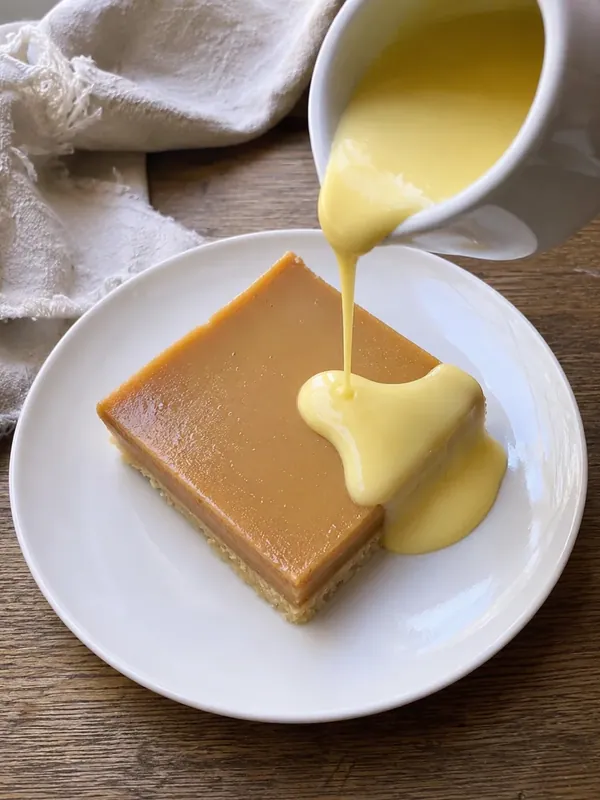
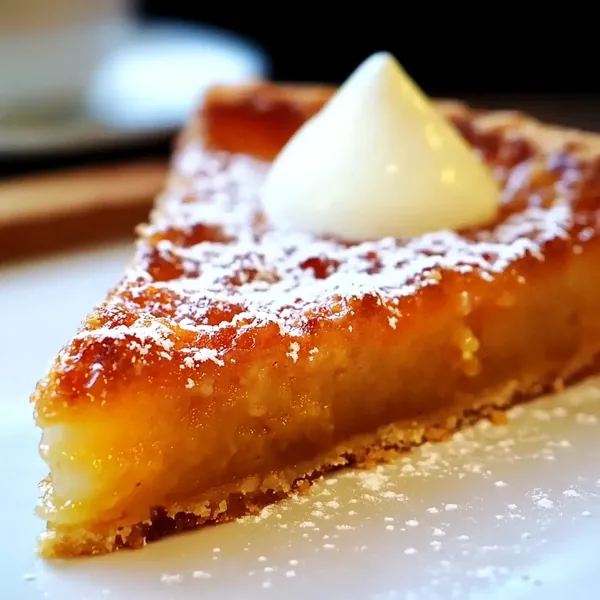
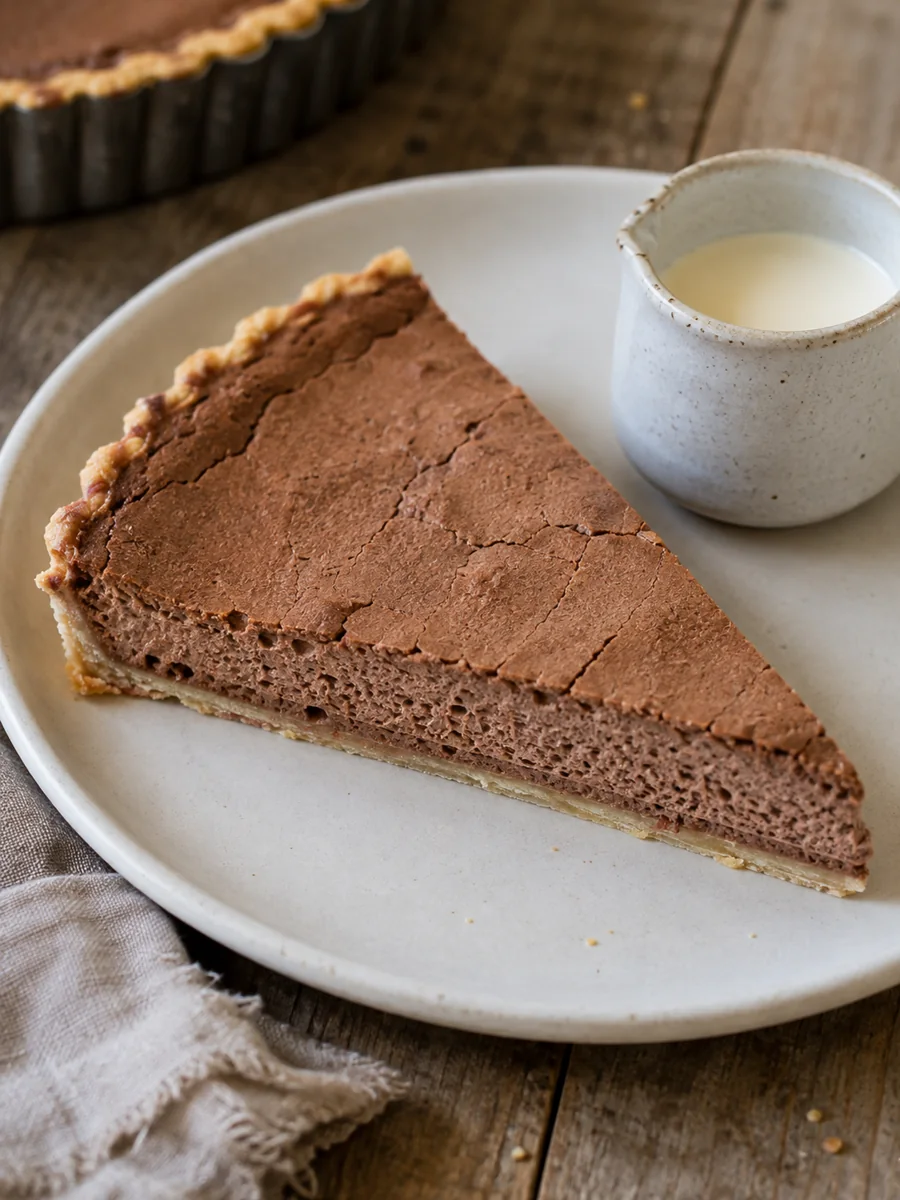
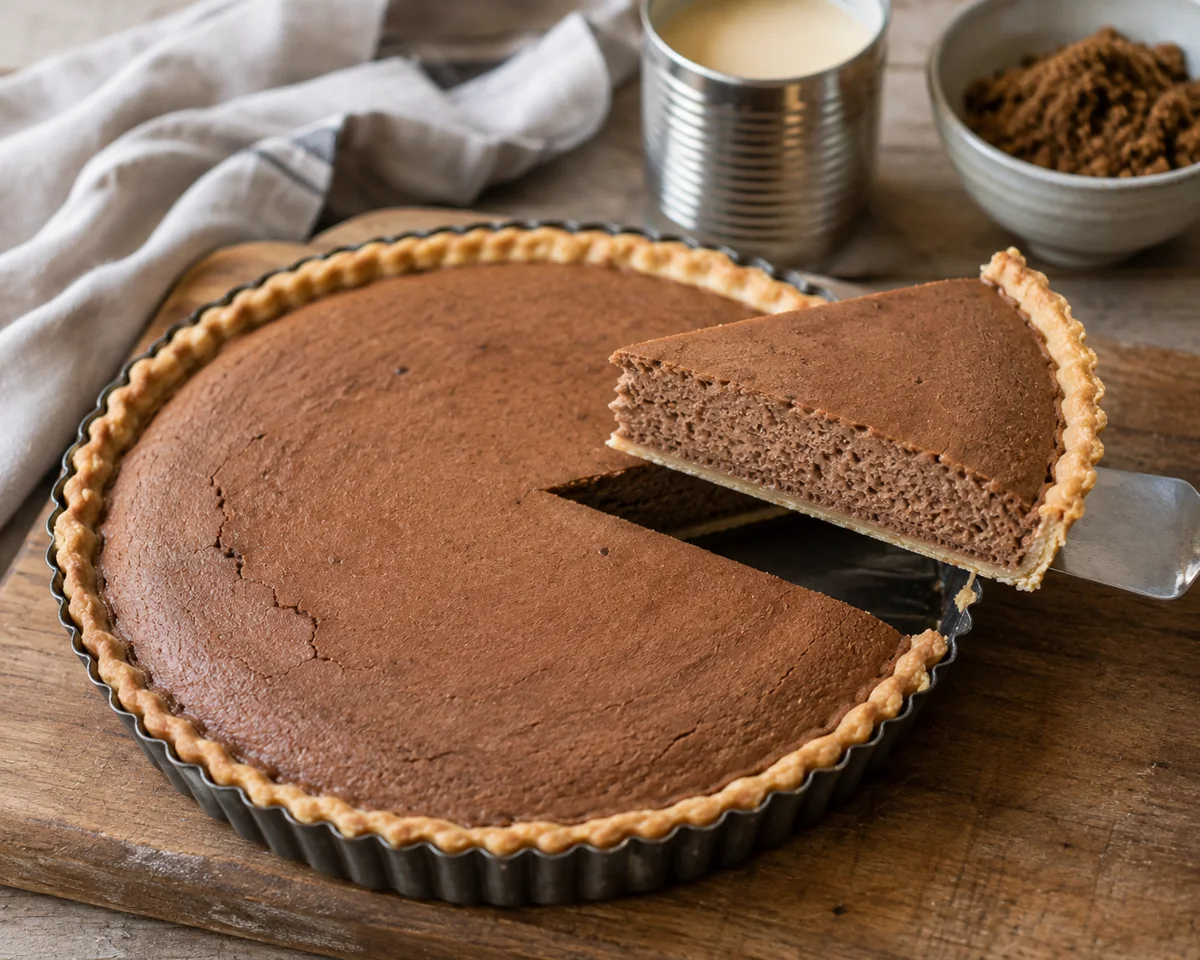
Gypsy tart is a sweet, open tart from Kent with a filling of evaporated milk and brown sugar (dark muscovado, traditionally) whipped together until thick and airy, poured into a blind-baked shortcrust case and baked just long enough to set. The finished filling is pale caramel-brown, soft and mousse-like, with a matte top that often has a few fine cracks – nothing like the dense, buttery filling of a butterscotch tart or the thick custard of a Manchester tart.
The usual story is that a Romany woman on the Isle of Sheppey made it in the 19th century from what she had to hand to feed hungry children – hence the name. Whether or not that’s true, the tart was a fixture on Kent school menus for most of the 20th century, which is why almost everyone who knows it knows it from childhood.
Why this recipe works
- Dark muscovado, not light brown sugar. The treacly depth of muscovado is the flavour of the tart. Light brown sugar gives you a paler, flatter, sweeter result.
- Whisk for 10–15 minutes. This isn’t optional. The mixture needs to go from thin and dark to thick, pale and glossy – like a loose mousse that holds a ribbon. Under-whisked filling stays liquid in the oven and never sets properly.
- Bake briefly and pull it out wobbly. The filling sets as it cools. Bake it until it looks “done” and you’ll get a weeping, sticky tart with a cracked, rubbery skin. Ten minutes is right in most ovens.
- Fully blind-baked pastry. Because the filling bakes for such a short time, the pastry has to be completely cooked and crisp before it goes in.
- Cooled completely before cutting. Warm gypsy tart is liquid. Cold gypsy tart slices beautifully.
Ingredients
For the shortcrust pastry (or use a 320g sheet of ready-rolled shortcrust):
- 225g plain flour
- 110g cold unsalted butter, cubed
- 1 tablespoon caster sugar
- a pinch of salt
- 1 egg yolk
- 2–3 tablespoons cold water
For the filling:
- 400g evaporated milk (one large tin), well chilled
- 250g dark muscovado sugar
That’s genuinely it. Some recipes add a teaspoon of vanilla; the original doesn’t need it.
To serve: pouring cream, cold custard, or – the school way – a small jug of evaporated milk.
How to make gypsy tart
1. Chill the evaporated milk
Put the unopened tin in the fridge for a few hours or overnight. Cold evaporated milk whips far more easily and holds more air – this single step halves the whisking time.
2. Make and chill the pastry
Rub the butter into the flour, sugar and salt until it looks like breadcrumbs. Add the egg yolk and enough cold water to bring it together into a dough without it feeling sticky. Flatten into a disc, wrap and chill for 30 minutes.
3. Line and blind bake
Heat the oven to 190°C / 170°C fan / gas 5. Roll the pastry out to about 3mm and line a 23cm loose-bottomed fluted tart tin, leaving a small overhang. Prick the base, line with baking paper and baking beans, and bake for 15 minutes. Remove the paper and beans and bake for another 8–10 minutes until the base is golden and completely dry. Trim the overhang while it’s warm and leave the case to cool in the tin. Turn the oven down to 180°C / 160°C fan / gas 4.
4. Whisk the filling – properly
Pour the cold evaporated milk into a large bowl and add the muscovado sugar, breaking up any lumps with your fingers. Using an electric hand whisk or a stand mixer on high, whisk for 10–15 minutes. It will start dark, thin and grainy; after five minutes it will be smooth and starting to thicken; by the end it should be noticeably paler – a light coffee colour – thick, glossy and frothy, and a ribbon of it trailed from the whisk should sit on the surface for a second before sinking. If you rub a little between your fingers there should be no grit.
5. Fill and bake – briefly
Pour the filling into the cooled case; it should come to just below the pastry edge. Bake for 10 minutes. The surface will turn matte and darken slightly at the edge, and the middle will still wobble like a just-set jelly when you nudge the tin. That’s correct – take it out.
6. Cool, then chill
Leave the tart in its tin until it’s completely cold, then refrigerate for at least 2 hours. The filling sets to a soft, sliceable texture as it chills. Cut with a knife dipped in hot water and wiped between slices.
Serving suggestions
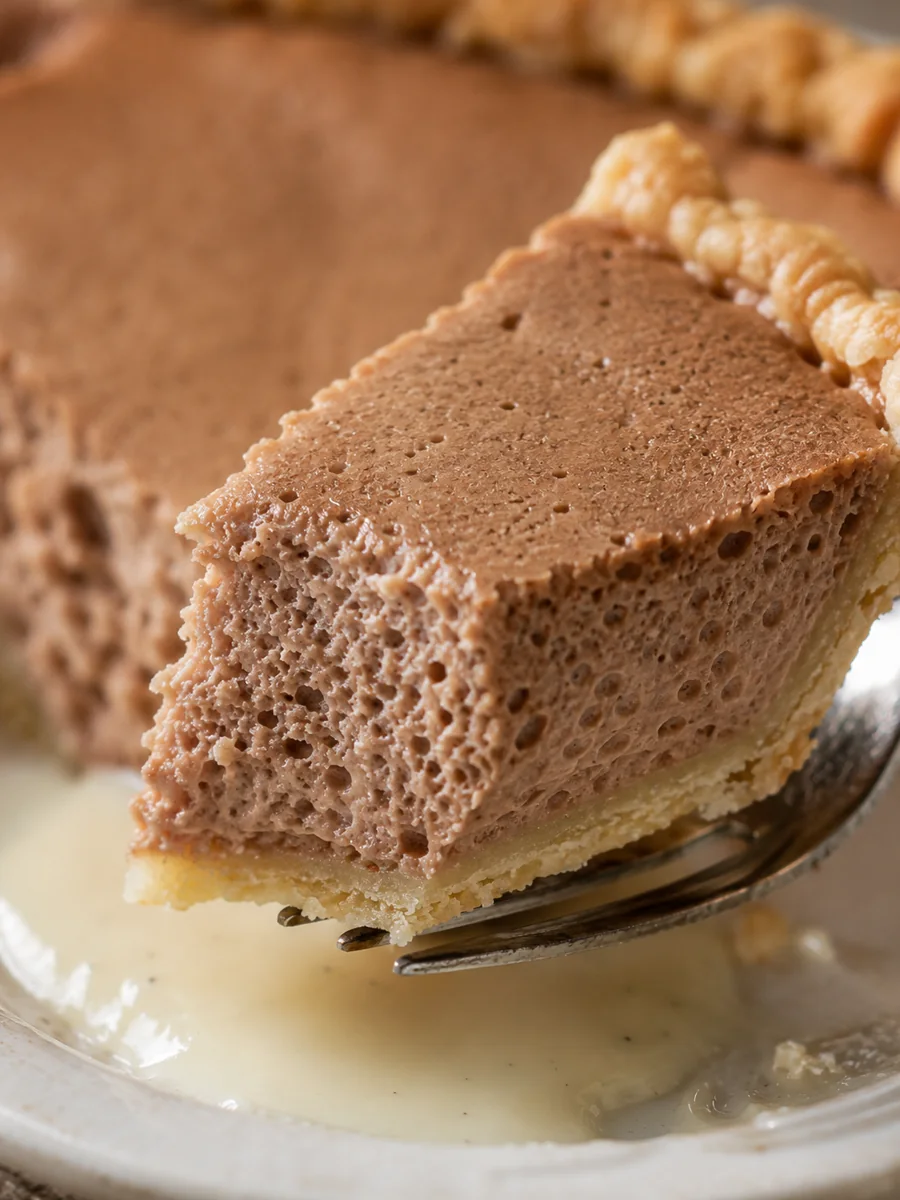
Gypsy tart is sweet – very sweet – so it wants something plain and cold alongside it: pouring cream, a spoonful of crème fraîche, or cold custard. A few raspberries or a little stewed rhubarb cut through the sugar nicely if you want to make it feel less like school and more like a dinner party. It’s also surprisingly good with a strong black coffee.
Slices are small for a reason: a 23cm tart serves 10–12 comfortably.
Troubleshooting
The tart “wept” – there’s sticky liquid on top or around the edge. The classic gypsy tart failure, and it has two causes: the filling was under-whisked (not enough air and sugar still undissolved) or the tart was over-baked, which makes the filling split and release syrup. Next time, whisk until genuinely thick and pale, and pull the tart out while the centre still wobbles.
The filling didn’t set at all. Usually cut too early. It needs to be fully cold – ideally a couple of hours in the fridge. If it’s still liquid after chilling overnight, it was under-whisked; the fix is in the whisking, not the baking.
The top is dark and rubbery. Over-baked. Reduce the time by a couple of minutes and check that your oven isn’t running hot.
The filling sank below the pastry edge. It will settle a little as it cools – that’s normal. If it collapsed dramatically, it was over-whisked past the point of holding air, or the oven was opened in the first few minutes.
Soggy base. The case wasn’t crisp before filling. It needs the full blind bake until golden and dry.
Variations
- Muscovado and treacle – swap 25g of the muscovado for black treacle for an even darker, more bitter-edged tart.
- Little gypsy tarts – the same quantities fill 12 deep tartlet cases; blind bake for 12 minutes plus 5, fill, and bake for 7–8 minutes.
- Gypsy tart with a biscuit base – a buttery digestive base (250g biscuits, 125g melted butter, chilled) works if you’d rather skip pastry, though it’s not traditional.
- Salted – a pinch of flaky sea salt on each slice is very good against all that sugar.
Make ahead and storage
Gypsy tart is best made the day before so it has plenty of time to set. Keep it covered in the fridge for up to 3 days; the pastry softens slightly after the first day but the filling is unaffected.
It doesn’t freeze well – the whipped filling separates as it thaws. The blind-baked pastry case on its own can be frozen for up to 3 months.
Frequently asked questions
Why is it called gypsy tart? The most repeated story is that a Romany woman on the Isle of Sheppey in Kent invented it to feed children with the cheap, long-life ingredients she had – tinned milk and sugar. It’s been on Kent school menus since at least the 1950s.
Can I use condensed milk instead of evaporated milk? No – condensed milk is already sweetened and far thicker, so the filling won’t whip or set the same way. It has to be unsweetened evaporated milk.
Can I use light brown sugar? You can, but the tart will be paler and taste mainly of sugar. Dark muscovado gives the caramel and toffee depth that makes a gypsy tart taste like one. Soft dark brown sugar is the nearest substitute.
How do I know when the filling is whisked enough? Colour and ribbon: it should be markedly lighter than when you started and thick enough that a trail from the whisk sits briefly on the surface. With chilled milk and an electric whisk this takes about 10 minutes; by hand it’s closer to 20.
Why is the middle still wobbly after baking? Because it’s meant to be. Gypsy tart sets in the fridge, not in the oven. A firm, fully set centre when it comes out means it’s over-baked and will likely weep.
Is gypsy tart the same as butterscotch tart? No. Butterscotch tart has a cooked butter-and-brown-sugar filling thickened with flour – dense and fudgy. Gypsy tart is whipped evaporated milk and sugar – light and airy. They’re often confused because both are brown, sweet, and served with custard at school.
More classic British puddings
Gypsy tart is part of our Classic British Bakes & Puddings collection. If you like the old-school tarts, try the butterscotch tart, the Manchester tart traybake and the traditional Bakewell pudding; for the custard-and-sponge side of the school dinner menu there’s sprinkle sponge with pink custard and chocolate concrete.
Gypsy Tart (Traditional Kent Recipe)
The classic Kent gypsy tart: a blind-baked shortcrust case filled with evaporated milk and dark muscovado sugar whisked until thick and pale, baked for just 10 minutes and chilled until set. Light, airy and very sweet - serve with cream or cold custard.
Ingredients
- 225g plain flour
- 110g cold unsalted butter, cubed
- 1 tablespoon caster sugar
- Pinch of salt
- 1 egg yolk
- 2-3 tablespoons cold water
- 400g evaporated milk (1 large tin), chilled
- 250g dark muscovado sugar
Instructions
Pastry
- Chill the unopened tin of evaporated milk for several hours or overnight.
- Rub the butter into the flour, sugar and salt until it resembles breadcrumbs. Add the egg yolk and enough cold water to form a dough. Wrap and chill for 30 minutes.
- Heat the oven to 190C / 170C fan / gas 5. Roll the pastry to 3mm and line a 23cm loose-bottomed tart tin. Prick the base, line with paper and baking beans and bake for 15 minutes, then remove the paper and beans and bake for 8-10 minutes more until golden and dry. Cool in the tin. Reduce the oven to 180C / 160C fan / gas 4.
Filling
- Put the chilled evaporated milk and the muscovado sugar in a large bowl. Whisk on high with an electric whisk for 10-15 minutes until thick, glossy and noticeably paler, with no grittiness and a ribbon that briefly holds on the surface.
- Pour the filling into the cooled pastry case and bake for 10 minutes. The surface should be matte and the centre should still wobble.
- Cool completely in the tin, then chill for at least 2 hours until set. Slice with a hot knife and serve with pouring cream or cold custard.
Nutrition
- Serving
- 1 slice
- Calories
- 310 calories