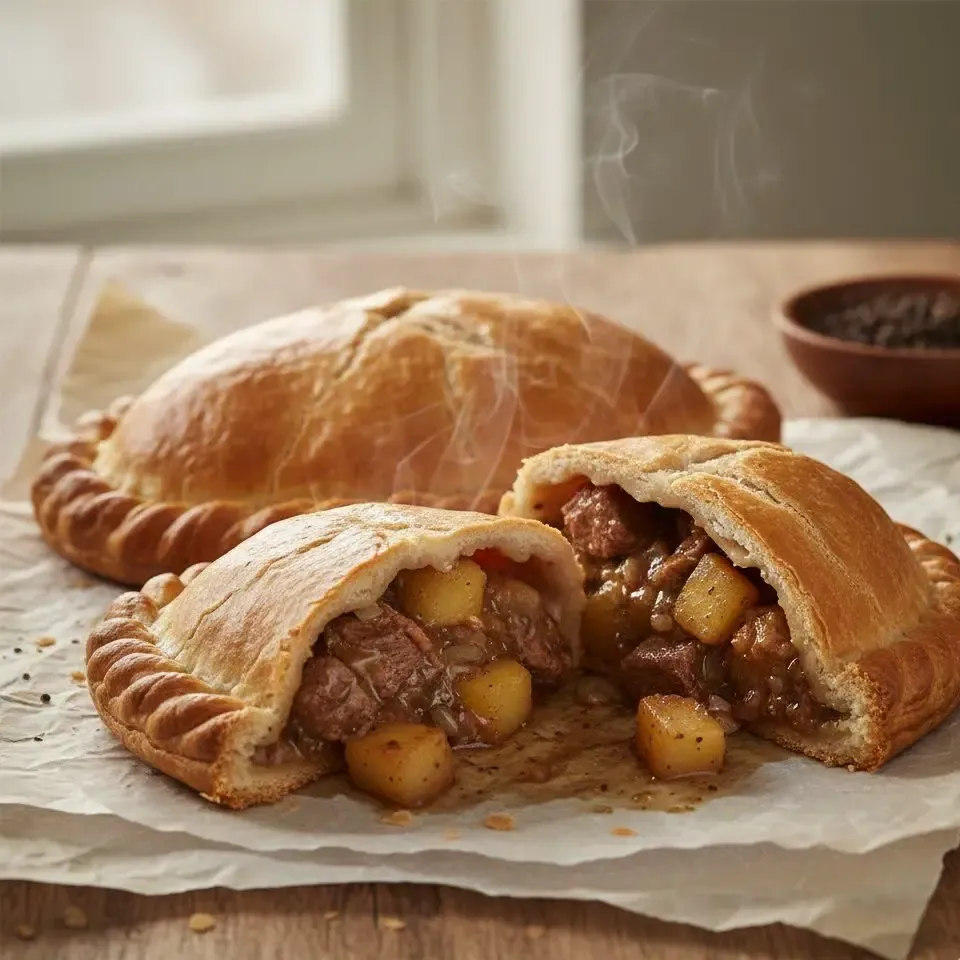
There is no British bake quite as iconic, brilliant, and deeply nostalgic as a proper, traditional Cornish pasty. While the high streets are full of pale, limp imitations stuffed with grey mince and soggy vegetables, a true Cornish pasty is a revelation of texture and robust flavour. It relies on a sturdy, golden, hand-crimped pastry shell encasing a seasoned filling of raw beef skirt, waxy potato, earthy swede, and onion that cooks in its own rich juices inside the oven.
Evelyn has been baking these pasties since she spent a childhood summer holiday near Padstow in the 1950s. She learned the authentic art of the “D-shape” and the side-crimp from a local baker who insisted that a pasty must be durable enough to survive a drop down a mine shaft—though ideally, it should only ever drop onto a plate. In this guide, you will learn the secrets to making proper pastry that won’t leak, choosing the exact right cut of beef, and mastering the famous Cornish crimp.
What Makes a Pasty “Cornish”?
The Cornish pasty is so historically significant that it holds Protected Designation of Origin (PDO) status in Europe and the UK. This means that to be commercially sold as a “Cornish Pasty,” it must be made in Cornwall to a very specific recipe.
The authentic filling must consist exclusively of chunky beef, sliced or diced potato, swede (historically called “turnip” in Cornwall, but it is definitively the yellow-fleshed rutabaga), and onion. The seasoning is strictly salt and generous amounts of cracked black pepper. Carrots are strictly forbidden. The ingredients must go into the pasty raw, allowing the beef fat and vegetable juices to mingle and create a rich, natural gravy as the pasty bakes. Finally, the edges must be crimped (not pressed with a fork), and the crimp must traditionally sit on the side, not over the top.
While you might be baking these in your own kitchen rather than a Cornish bakery, following these golden rules guarantees you recreate that unmistakable, rugged, savory perfection.
If you enjoy proper, hearty, savoury British baking, you must also try our classic Steak and Mushroom Pie or our warming Toad in the Hole.
Ingredients for a Traditional Cornish Pasty
The success of a pasty lies in the quality of its simple, raw ingredients. Read the list carefully before beginning.
For the Strong Shortcrust Pastry
A pasty needs a pastry tough enough to hold heavy, wet ingredients without tearing, but rich enough to taste delicious.
| Ingredient | Quantity | Notes |
|---|---|---|
| Strong bread flour | 500 g | The higher gluten gives the pastry strength (plain flour can be substituted) |
| Lard | 125 g | Cold and diced; provides incredible crispness |
| Unsalted butter | 125 g | Cold and diced; provides rich flavour |
| Sea salt | 1 tsp | Essential for seasoning the crust |
| Ice-cold water | 150-175 ml | Added gradually to bind the dough |
For the Raw Filling
| Ingredient | Quantity | Notes |
|---|---|---|
| Beef skirt | 450 g | Trimmed of heavy gristle and diced roughly into 1cm cubes |
| Waxy potatoes | 350 g | Peeled and diced into 1cm cubes (Maris Piper works well) |
| Swede (rutabaga) | 200 g | Peeled and diced into 1cm cubes |
| Onion | 150 g | Peeled and finely chopped |
| Sea salt | 2 generous tsp | Crucial for drawing juices and flavour |
| Black pepper | 2 generous tsp | Freshly cracked is non-negotiable for the peppery kick |
| Butter (optional) | A few small knobs | Dotted over the filling before sealing for extra richness |
| Large egg | 1 | Beaten with a splash of milk to glaze |
[!TIP] Why Beef Skirt? Finding the right beef is the single most important decision in this recipe. Beef skirt is traditional because it cooks quickly, boasts a rich, deeply meaty flavor, and possesses just enough fat to melt down and create a gravy inside the pasty without leaving chewy, fatty lumps. It has no gristle. Do not use generic “stewing steak,” “braising steak,” or minced beef—they will result in tough meat or a dry pasty.
Equipment You Need
Making decent pasties is a hands-on affair. Make sure you have the following:
- Two large, heavy baking trays
- Baking parchment
- A large mixing bowl
- Cling film
- A rolling pin
- A sharp knife
- A small bowl of cold water (for sealing)
- A pastry brush
How to Make Traditional Cornish Pasties (Step-by-Step)
Do not attempt to rush the pastry chilling; it is the difference between a flaky pasty and one that shrinks and splits in the oven.
Preparing the Pastry
Step 1: Rub in the Fats
Place the strong bread flour and sea salt into a large mixing bowl. Drop in the cold, diced lard and unsalted butter. Using just your fingertips, quickly rub the fats into the flour, lifting the mixture up to aerate it as you work. Stop when the mixture resembles fine breadcrumbs.
Step 2: Bind and Knead
Make a well in the centre of the flour. Gradually pour in the ice-cold water, using a cutlery knife to stir and bring the dough together. Once it begins to clump, use your hands to gather it into a ball.
Unlike delicate tart pastry, pasty dough requires kneading to develop the gluten. Tip the dough onto a lightly floured surface and knead it firmly for 2 to 3 minutes until it becomes smooth and surprisingly elastic. Wrap the dough tightly in cling film and chill in the fridge for at least 3 hours (overnight is even better).
Preparing the Filling
Step 3: Chop and Mix
While the pastry chills, prepare the filling. Place the diced beef skirt, diced potato, diced swede, and chopped onion into a very large bowl. Add the two teaspoons of sea salt and two heavily heaped teaspoons of freshly cracked black pepper. Toss the mixture thoroughly with your hands to ensure the seasoning is perfectly distributed. Do not cook this mixture; leave it entirely raw.
Assembling the Pasties
Step 4: Portion and Roll
Preheat your oven to 180 degrees Celsius (160 degrees fan). Line your baking trays with baking parchment.
Take the chilled dough from the fridge and cut it equally into four massive pieces (or six for medium pasties). Roll the first piece of dough on a lightly floured surface into a rough circle, about 20-22 cm (8-9 inches) in diameter and roughly 3mm thick.
Step 5: Fill the Pastry
Spoon a generous quarter of the raw meat and vegetable mixture onto the middle of the pastry circle. Slightly offset the filling toward one side to make folding easier. Make sure the filling forms a neat mound, leaving a clear margin around the edges of the pastry. If desired, drop a small knob of cold butter on top of the filling mound for extra richness.
Step 6: Seal and Fold
Dip your finger in a bowl of cold water and run it lightly around the entire perimeter of the pastry circle. Carefully fold the empty side of the pastry over the filling to meet the other edge, creating a large D-shape. Press the edges firmly together with your fingers to seal the pasty, carefully pushing out any trapped air as you seal it.
Step 7: The Master Crimp
Now for the famous Cornish crimp. Start at the right-hand corner of the D-shape (if you are right-handed). Fold the very corner of the pastry triangle diagonally inward. Hold that fold with your thumb, then use your forefinger to grab the pastry just beside it, pinch it together, twist it slightly, and fold it diagonally over the previous fold. Repeat this rolling, twist-and-fold motion all the way around the curve, pressing down firmly each time to create a neat, roped edge. Tuck the final end neatly underneath the pasty to prevent it unwinding. Transfer the crimped pasty to the lined baking tray.
Repeat Steps 4-7 for the remaining three pasties.
Glazing and Baking
Step 8: Glaze and Vent
Brush each pasty thoroughly all over carefully with the beaten egg and milk glaze. This gives them a highly coveted, deeply golden shine. Finally, use the tip of a sharp knife to carefully poke a small slit or hole right in the very top of each pasty. This allows steam to escape during baking and stops the pasty from bursting open at the seams.
Step 9: Bake
Bake the pasties in the preheated oven for 50 to 55 minutes. You are looking for a deep, rich, golden-brown colour across the pastry. The length of time allows the raw beef and root vegetables inside to cook perfectly.
Remove the pasties from the oven and transfer them to a wire cooling rack. The filling will be fiercely hot, so allow them to rest and cool for at least 20 minutes before taking your first bite.
Troubleshooting Your Pasties
Even seasoned bakers find pasties challenging at first. Here is how to correct common mistakes.
My Pastry Split in the Oven
Pastry splits when the dough wasn’t kneaded enough (it lacked gluten strength), when it wasn’t chilled for long enough (the butter melted too quickly), or when you forgot to cut a steam hole in the top. If a pasty does split slightly, don’t panic; it will still taste incredible, though you may lose a little gravy. Ensure you fold the dough generously without stretching it tightly over the filling.
The Potatoes Are Hard
If your filling is crunchy, the pasties were either removed from the oven too early, or your diced pieces of potato and swede were too large. The vegetables must be diced no larger than 1cm squared to ensure they cook through completely within the 55-minute baking window.
The Bottom is Soggy or Soft
Classic soggy bottoms occur when the baking tray wasn’t hot enough, or if the pasties sit in their own leaked juices. To prevent this, place your heavy baking trays in the oven to preheat alongside the oven, and slide the parchment paper carrying the pasties directly onto the hot trays. The immediate blast of underside heat sets the base pastry crisp instantly.
Serving and Storage
How to Serve a Cornish Pasty
A pasty needs absolutely no accompaniments. It is a complete meal in a pastry envelope, designed to be held in the hand and eaten on the go, perhaps wrapped in a greaseproof paper bag or napkin. However, if serving them for a sit-down meal, they pair wonderfully with an incredibly simple, sharp green salad or a dollop of decent piccalilli on the side. They are fabulous hot, but arguably even better served cold the next day.
How to Store Pasties
Once completely cold, store pasties in an airtight container or wrap them tightly in foil and keep them in the fridge for up to three days. To reheat them, place them on a baking tray in a preheated oven at 180 degrees Celsius for 15-20 minutes until piping hot throughout. Never reheat pasties in a microwave; the pastry will become miserably wet, soft, and rubbery.
Can You Freeze Homemade Pasties?
Yes, and they freeze sensationally well unbaked. Prepare the pasties right up to the final stage (crimped and sealed), but do not brush them with the egg wash. Freeze them on a tray until solid, then transfer them to a freezer bag for up to three months. To bake from frozen, simply place them on a baking tray, brush with egg wash, cut the steam hole, and bake at 180 degrees Celsius, adding 15 to 20 extra minutes to the baking time.
Frequently Asked Questions (FAQ)
What is the “crimp” for?
Historically, the thick crimped edge of a Cornish pasty served as a “handle.” Tin miners, whose hands were covered in toxic arsenic and tin dust from the mines, would hold the pasty by the crimped edge to eat the filling, and then discard the dirty crust. Today, the thick crust provides a brilliantly satisfying crunch, and we eat the whole thing.
Why do you use raw meat and vegetables?
This is the defining characteristic of a Cornish pasty. Because the raw ingredients are sealed inside the pastry casing, they steam and roast in their own natural juices. The fat from the beef skirt melts into the starchy potato and swede, creating an incredibly rich, intensely flavoured internal gravy that simply cannot be replicated by pre-cooking the filling.
I can’t find beef skirt; what is the best alternative?
If your butcher does not have beef skirt, ask for finely diced chuck steak or braising steak. Ensure you trim away absolutely all visible gristle and tough fat before using it, and chop it very small (under 1cm). Whatever you do, do not use minced beef; the texture will be entirely wrong.
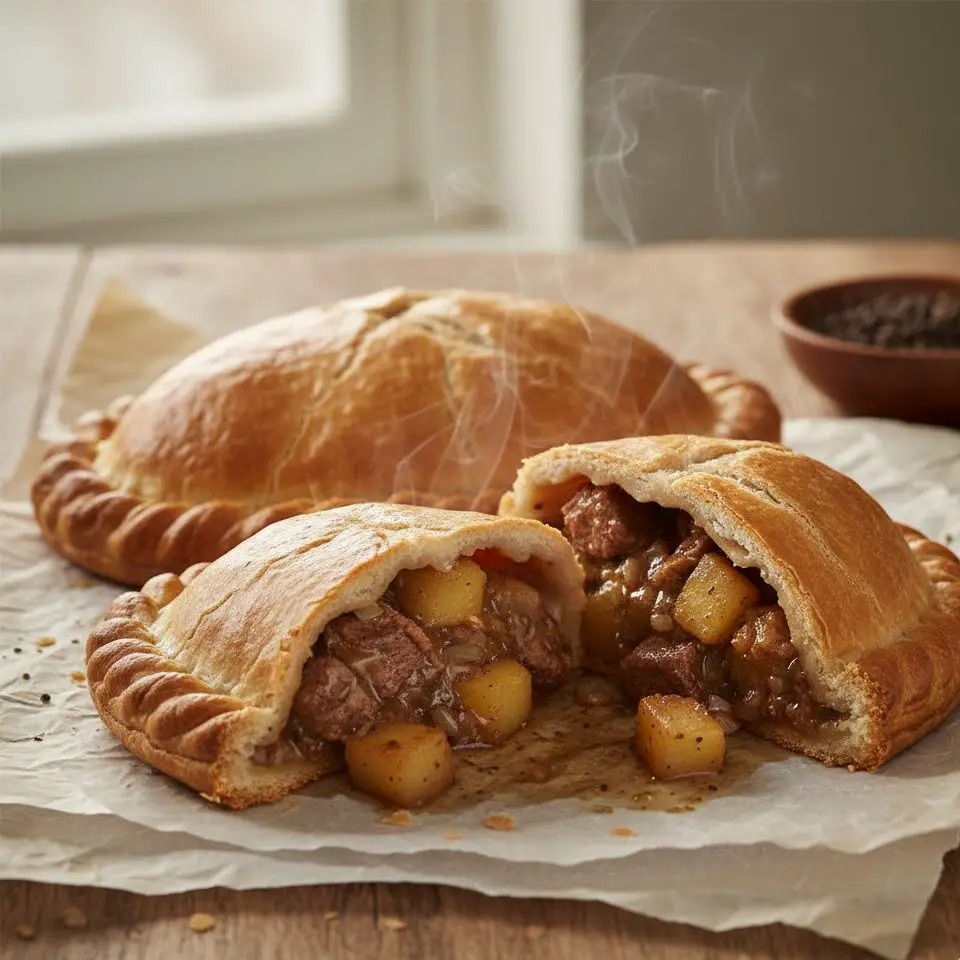
Traditional Cornish Pasty Recipe: Authentic Beef & Vegetable Pasties
A proper traditional Cornish pasty recipe made with robust golden shortcrust pastry encasing a filling of raw beef skirt, waxy potato, earthy swede, and onion, all seasoned generously with black pepper.
Ingredients
- 500 g strong bread flour (or plain flour)
- 125 g cold lard, diced
- 125 g cold unsalted butter, diced
- 1 tsp sea salt
- 150-175 ml ice-cold water
- 450 g beef skirt, trimmed of gristle and diced into 1cm cubes
- 350 g waxy potatoes (e.g., Maris Piper), peeled and diced into 1cm cubes
- 200 g swede (rutabaga), peeled and diced into 1cm cubes
- 150 g onion, peeled and finely chopped
- 2 tsp sea salt
- 2 tsp freshly ground black pepper
- Knobs of butter (optional, for placing inside each pasty)
- 1 large egg, beaten with a splash of milk
Instructions
- To make the pastry, place the flour and salt into a large bowl. Rub in the cold diced lard and butter using your fingertips until the mixture resembles fine breadcrumbs.
- Gradually add the ice-cold water, mixing with a cutlery knife, until the dough clumps together. Use your hands to bring the dough into a ball. Knead firmly for 2 to 3 minutes until smooth and elastic. Wrap in cling film and chill in the fridge for at least 3 hours (or overnight).
- Preheat the oven to 180 degrees Celsius (160 fan). Line two large baking trays with baking parchment.
- To prepare the filling, place the diced beef, potato, swede, and onion into a large bowl. Season very generously with the sea salt and black pepper. Mix thoroughly.
- Divide the chilled pastry into four equal pieces. On a lightly floured surface, roll each piece into a circle roughly 20-22 cm (8-9 inches) in diameter and 3mm thick.
- Place a quarter of the filling onto the middle of one pastry circle, slightly offset to one side. If using, place a small knob of butter on top of the filling.
- Brush the edges of the pastry lightly with water. Fold the pastry over the filling to create a semi-circle, pressing the edges firmly together to seal and expel any air.
- To crimp the edge, start at one end. Pinch and twist the pastry edge inward, repeating this rolling motion all the way along the curve to form a neat rope-like seal. Tuck the very ends underneath. Place on the prepared baking tray. Repeat for the remaining pasties.
- Brush the pasties all over with the beaten egg and milk glaze. Use a sharp knife to pierce a small slit in the top of each pasty to allow steam to escape.
- Bake in the preheated oven for 50 to 55 minutes, until the pastry is deeply golden brown and crisp, and the filling is cooked through.
- Leave the pasties to cool on a wire rack for at least 20 minutes before eating, as the filling stays fiercely hot. Serve warm or cold.
Nutrition
- Serving
- 1 large pasty
- Calories
- 850 calories
- Sugar
- 6
- Sodium
- 1150
- Fat
- 48
- Saturatedfat
- 24
- Unsaturatedfat
- 18
- Transfat
- 1
- Carbohydrate
- 72
- Fiber
- 6
- Protein
- 32
- Cholesterol
- 115