In this article
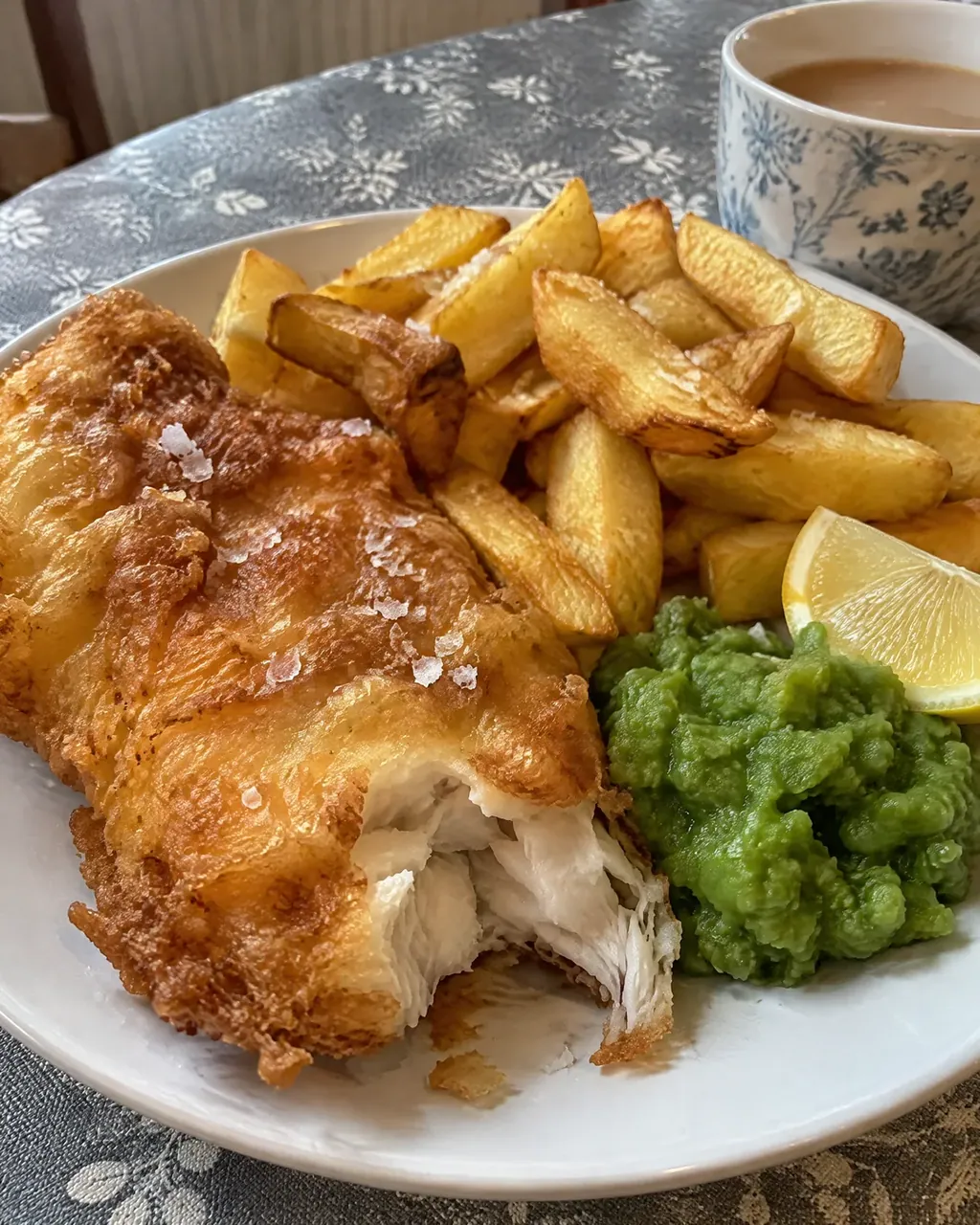
My friend Margaret told me that fish and chips were never rationed in Britain, not in the First World War and not in the Second, because the government understood the country would not keep going without them. Then she told me the real argument, the one that still divides her country: cod or haddock. Margaret grew up in the North of England, where it is haddock and nothing else. In the South it is cod, and she says a Southerner who asks for haddock up North gets a look. There is a chip shop on nearly every high street in England, and on a Friday night the line goes out the door.
At home her method is simple and it never fails. The fish is patted completely dry and dusted with flour so the batter grips. The batter is just flour, baking powder, salt and very cold sparkling water, so cold it fizzes against the bowl, and it goes on at the last second before the fish slides into hot oil. That cold batter hitting hot oil is what makes it puff up light and crackly instead of heavy and greasy. The chips are thick, cut from floury potatoes, and fried twice: once at a lower heat until soft, then again hot until golden. Here are her exact measurements, temperatures and the batter.
Why this fish and chips works
- Ice-cold sparkling water. The bubbles and the cold make a thin, lacy batter that puffs and stays crisp.
- A flour dusting first. Dry, floured fish holds the batter so it does not slide off in the oil.
- Batter mixed at the last minute. Lumpy is fine. Overmixed batter goes tough and bready.
- Chips fried twice. The first fry cooks the inside soft, the second fry crisps the outside.
- Floury potatoes. Russets go fluffy inside, the way a chip shop chip should.
Ingredients
Serves 4. The measurements are in US cups with grams in brackets, the grams being Margaret’s British weights. You need a deep heavy pot and a thermometer.
For the chips
- 2 pounds russet potatoes, peeled (900g)
- Vegetable or peanut oil for deep frying
- Fine salt, to serve
For the fish
- 4 thick cod or haddock fillets, skinless (about 6 ounces each, 170g)
- 1/4 cup all-purpose flour for dusting (30g)
- 1/2 teaspoon fine salt
For Margaret’s batter
- 1 1/4 cups all-purpose flour (155g)
- 1/4 cup cornstarch (30g)
- 2 teaspoons baking powder
- 1 teaspoon fine salt
- 1 1/4 cups ice-cold sparkling water (300ml)
To serve
- Vinegar, for sprinkling
- Lemon wedges
- Mushy peas or garden peas (optional)
Choose thick fillets of cod or haddock, at least 3/4 inch thick, so the fish stays moist while the batter crisps. Keep the sparkling water in the coldest part of the refrigerator until the moment you mix the batter.
How to make fish and chips
Chips, first fry
- Cut the potatoes into thick chips about 1/2 inch wide. Rinse them in cold water until the water runs clear, then dry them completely on a clean towel.
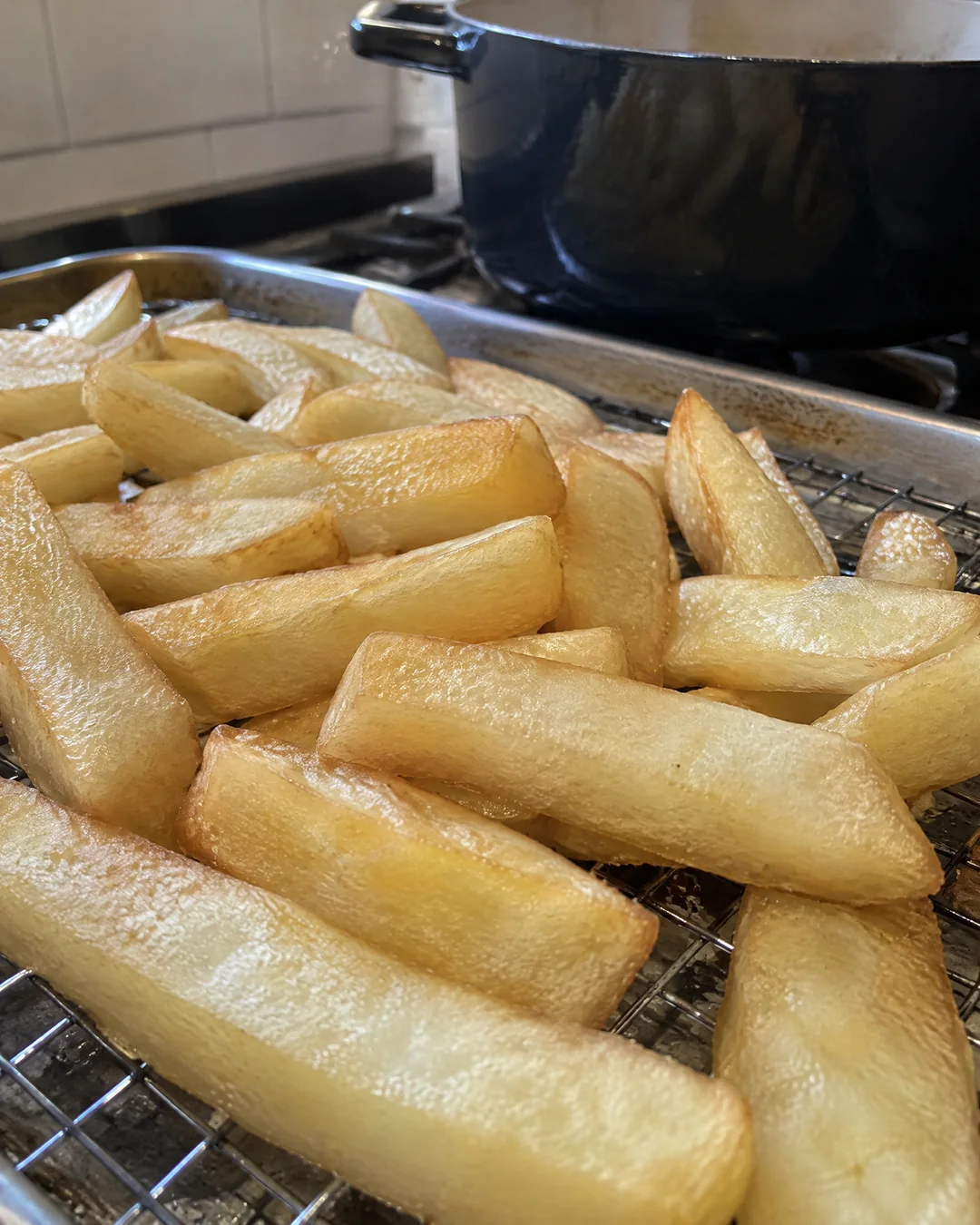
- Heat at least 3 inches of oil in a deep heavy pot to 300 degrees (150°C). Fry the chips in batches for 6 to 8 minutes, until soft all the way through but still pale. Lift them out onto a rack and let them rest.
Fish
- Pat the fish fillets completely dry with paper towels. Season with salt and dust them all over with flour, shaking off the extra.
- Raise the oil temperature to 350 degrees (175°C).
- Only now make the batter: whisk the flour, cornstarch, baking powder and salt in a bowl, pour in the ice-cold sparkling water and stir just until combined. A few lumps are fine.
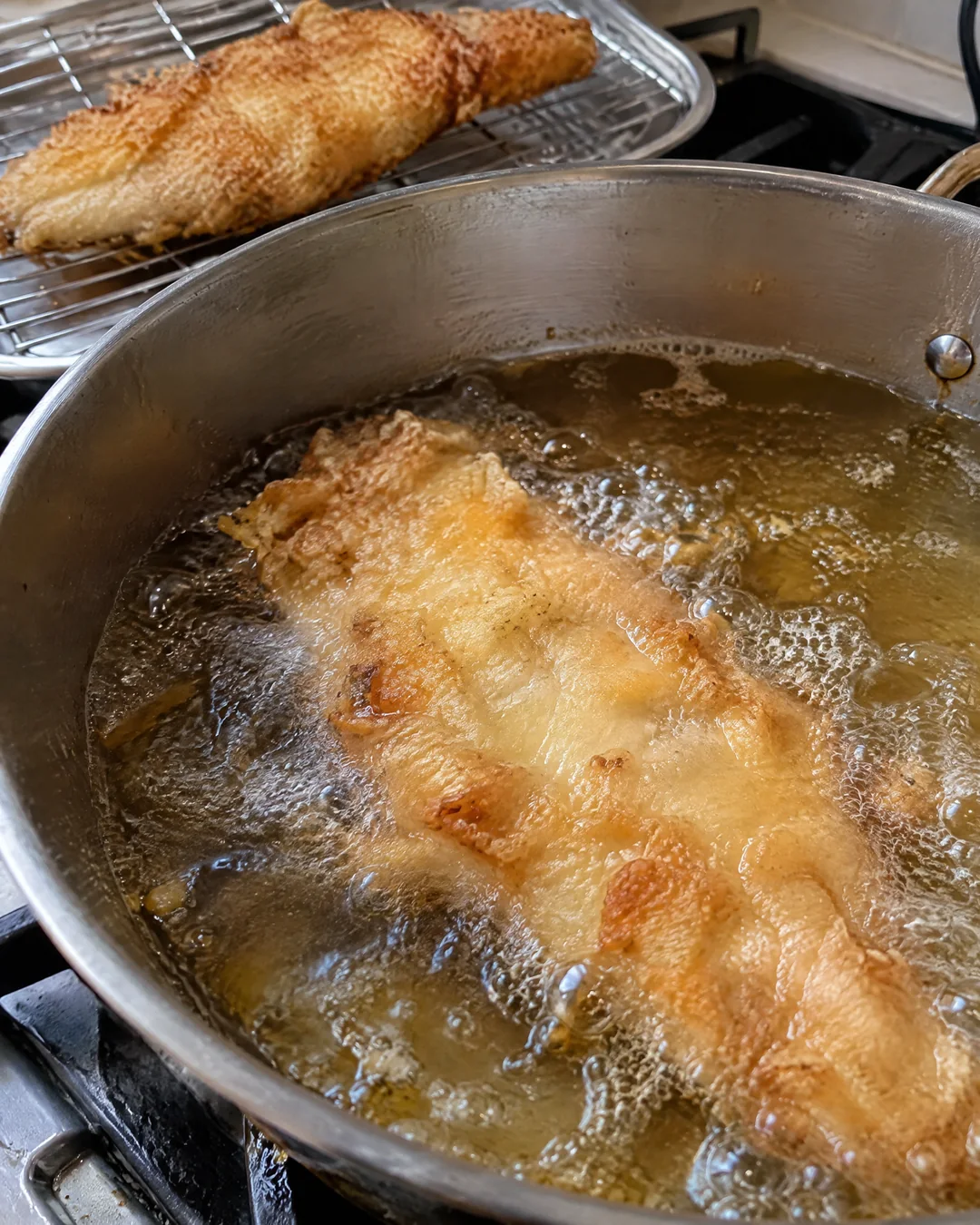
- Dip one fillet at a time in the batter, let the extra drip off for a second, then lower it into the oil away from you. Fry 2 fillets at a time for 5 to 7 minutes, turning once, until puffed, crisp and deep golden. Drain on a rack and keep warm in a low oven.
Chips, second fry
- Bring the oil up to 375 degrees (190°C). Fry the chips again in batches for 2 to 3 minutes until crisp and golden.
- Drain them and salt them the second they come out of the oil. Serve straight away with the fish, vinegar, lemon and peas.
Tips that make the difference
- Use a thermometer. Oil that is too cool makes greasy batter, oil that is too hot browns it before the fish is cooked.
- Never crowd the pot. Two fillets at a time keeps the oil hot and the batter crisp.
- Drain fried food on a wire rack, not paper towels, so the bottoms stay crisp.
- The first fry of the chips can be done an hour ahead. Do the second fry just before serving.
Variations
- Haddock or cod. Margaret is a haddock woman, but either works; pollock and halibut are good too.
- Oven chips. Toss the dried chips in oil and roast at 425 degrees for 35 to 40 minutes, turning once, if you would rather not fry them.
- Mushy peas. Simmer frozen peas with a knob of butter and a splash of water, then mash roughly with salt and pepper.
- Tartar sauce. Mix mayonnaise with chopped pickles, capers, lemon juice and parsley for a dipping sauce.
Storage and make-ahead
Fish and chips are best eaten the minute they are fried. The batter softens as it cools.
Leftovers keep in the refrigerator for 1 day. Reheat on a rack in a 400 degree oven for 8 to 10 minutes to crisp them again. Never use the microwave.
Let the frying oil cool, strain it and keep it covered for one more batch of fish.
Frequently asked questions
Why use sparkling water in the batter?
The bubbles lighten the batter and the cold slows the gluten, so it fries thin and crackly instead of thick and bready.
Should I use cod or haddock?
Both are traditional. Cod is the favourite in the South of England and haddock in the North. Haddock is slightly sweeter, cod flakes into bigger pieces.
Why fry chips twice?
The first, gentle fry cooks the potato through until fluffy. The second, hotter fry gives the crisp golden shell. One fry gives either raw centers or soft chips.
What vinegar goes on fish and chips?
In Britain it is a plain brown vinegar sprinkled over everything at the counter. Any mild vinegar you like works at home, with plenty of salt.
Thick chips, a light batter, salt and vinegar, and the old argument about cod or haddock. Margaret says the best ones are eaten out of the paper, by the sea, with your fingers.
British Fish and Chips with Margaret's Light Crispy Batter
Classic British fish and chips at home the way Margaret makes them: cod or haddock in a light crispy batter made with ice-cold sparkling water, and thick chips fried twice. With salt, vinegar and mushy peas. US cups with grams.
Ingredients
- 2 pounds russet potatoes, peeled
- Vegetable or peanut oil for deep frying
- Fine salt, to serve
- 4 thick cod or haddock fillets, skinless
- 1/4 cup all-purpose flour for dusting
- 1/2 teaspoon fine salt
- 1 1/4 cups all-purpose flour
- 1/4 cup cornstarch
- 2 teaspoons baking powder
- 1 teaspoon fine salt
- 1 1/4 cups ice-cold sparkling water
- Vinegar, for sprinkling
- Lemon wedges
- Mushy peas or garden peas
Instructions
- Cut the potatoes into thick chips about 1/2 inch wide. Rinse them in cold water until the water runs clear, then dry them completely on a clean towel.
- Heat at least 3 inches of oil in a deep heavy pot to 300 degrees (150°C). Fry the chips in batches for 6 to 8 minutes, until soft all the way through but still pale. Lift them out onto a rack and let them rest.
- Pat the fish fillets completely dry with paper towels. Season with salt and dust them all over with flour, shaking off the extra.
- Raise the oil temperature to 350 degrees (175°C).
- Only now make the batter: whisk the flour, cornstarch, baking powder and salt in a bowl, pour in the ice-cold sparkling water and stir just until combined. A few lumps are fine.
- Dip one fillet at a time in the batter, let the extra drip off for a second, then lower it into the oil away from you. Fry 2 fillets at a time for 5 to 7 minutes, turning once, until puffed, crisp and deep golden. Drain on a rack and keep warm in a low oven.
- Bring the oil up to 375 degrees (190°C). Fry the chips again in batches for 2 to 3 minutes until crisp and golden.
- Drain them and salt them the second they come out of the oil. Serve straight away with the fish, vinegar, lemon and peas.