In this article
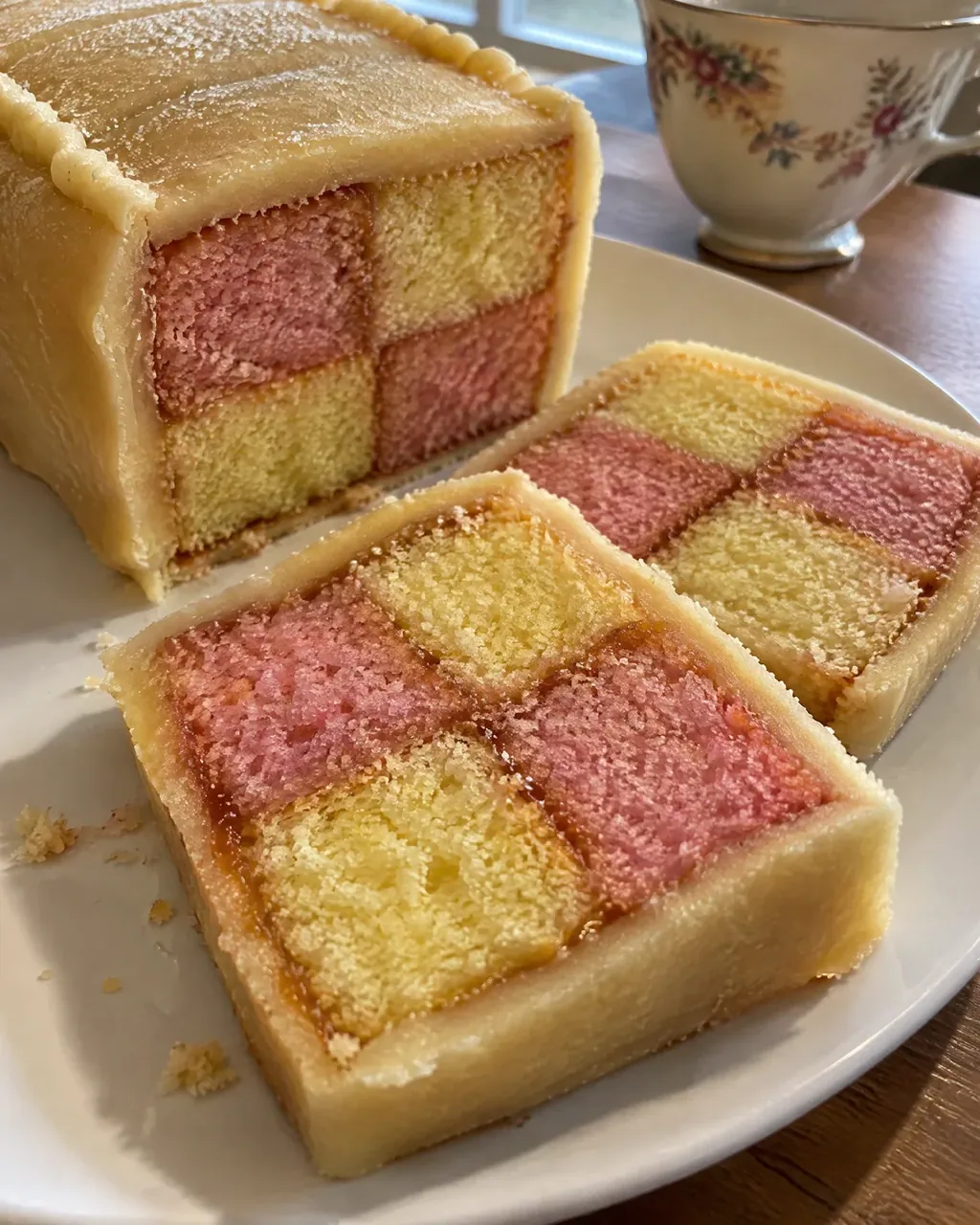
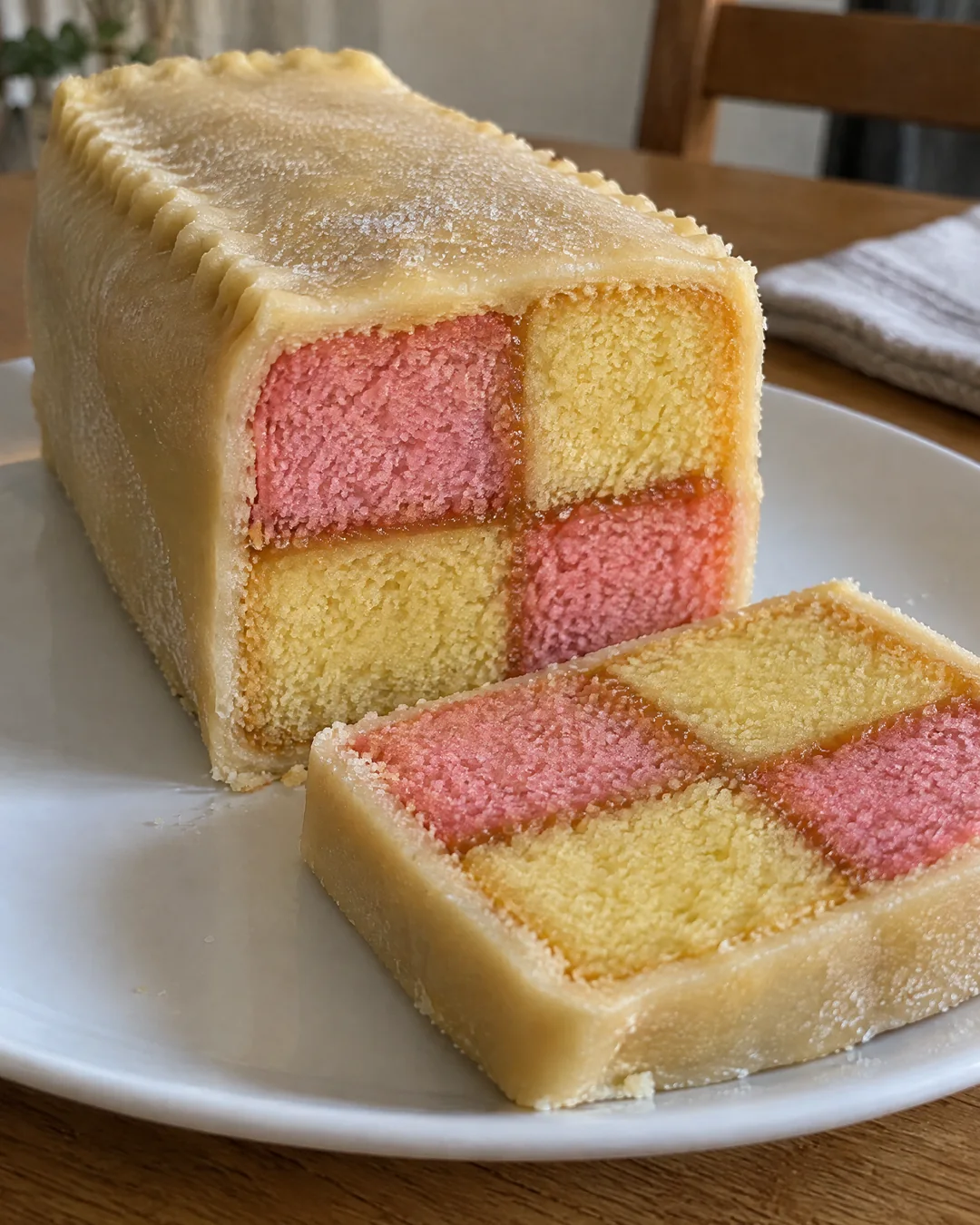
My friend Margaret grew up in England, where a Battenberg cake sits on the tea table at every grandmother’s house and in the window of every corner bakery. In America we would call it the checkerboard cake, and when you cut a slice you see why: four neat squares of sponge, two pink and two pale yellow, held together with a thin line of apricot jam, the whole thing wrapped in a smooth blanket of marzipan. The story goes that it was first made in 1884 for a royal wedding in Queen Victoria’s own family, when Prince Louis of Battenberg married into it, and that the four squares stood for the four Battenberg princes. Margaret admits she has no idea whether the princes part is true, and she tells it every single time she cuts one anyway.
It looks like a cake for a professional, but Margaret’s method is very homely. One almond sponge batter, split in half, one half tinted pink. Both halves bake together in a single square pan divided down the middle with a fold of foil, so you only bake once. When the sponges are cool you trim them into four long strips of exactly the same size, brush them with warm apricot jam, press them together in a checkerboard and roll the whole thing in marzipan. The trimming is the part that matters. Margaret says if the strips are uneven, the checkerboard goes crooked, and everybody will notice.
Why this Battenberg cake works
- One pan, two colors. A strip of folded foil down the middle of an 8 inch pan bakes the plain and the pink sponge side by side in the same time.
- A firm, fine sponge. A little ground almond and a careful bake give a sponge that slices cleanly into strips without crumbling.
- Apricot jam as glue. Warm, sieved apricot jam holds the squares together and seals the outside so the marzipan sticks, without adding a strong flavor.
- Trim everything square. Cutting off the domed tops and the browned sides is what gives the clean, even checkerboard.
Ingredients
Makes one Battenberg loaf about 8 inches long, 10 slices. The measurements are in US cups with grams in brackets, the grams being the British weights.
For the sponge
- 3/4 cup unsalted butter (175g), soft
- 3/4 cup plus 2 tablespoons superfine or granulated sugar (175g)
- 3 large eggs, at room temperature
- 1 1/4 cups all-purpose flour (155g)
- 1/3 cup ground almonds or almond flour (35g)
- 2 teaspoons baking powder
- 1/4 teaspoon fine salt
- 2 tablespoons whole milk (30ml)
- 1/2 teaspoon almond extract
- 1/2 teaspoon vanilla extract
- A few drops of red or pink food coloring
To assemble
- 1/2 cup apricot jam (160g)
- 8 ounces marzipan (225g)
- Powdered sugar, for rolling
- 1 teaspoon granulated sugar, for sprinkling
Buy plain golden or white marzipan, or make your own from ground almonds, powdered sugar and egg white. Sieve the apricot jam after warming it so there are no lumps of fruit in the glue lines.
How to make Battenberg cake
- Heat the oven to 350 degrees (175°C). Grease an 8 inch square pan. Fold a long piece of foil into a strip about 2 inches high and set it down the middle of the pan to make two equal halves, then line both halves with parchment.
- Beat the butter and sugar together for 3 to 4 minutes, until pale and fluffy.
- Beat in the eggs one at a time, adding a spoonful of the flour with the last egg so the mixture does not curdle.
- Fold in the rest of the flour, the ground almonds, baking powder and salt, then the milk, almond extract and vanilla, until smooth.
- Weigh or measure the batter into two equal portions. Tint one portion pink with a few drops of coloring, stirring until even.
- Spoon the plain batter into one side of the pan and the pink into the other. Smooth both tops.
- Bake for 25 to 30 minutes, until risen, springy and a toothpick comes out clean. Cool 10 minutes in the pan, then lift out and cool completely on a rack.
- Trim the domed tops and the browned sides off both sponges. Cut each sponge in half lengthways so you have four long strips, two plain and two pink, all exactly the same width and height.
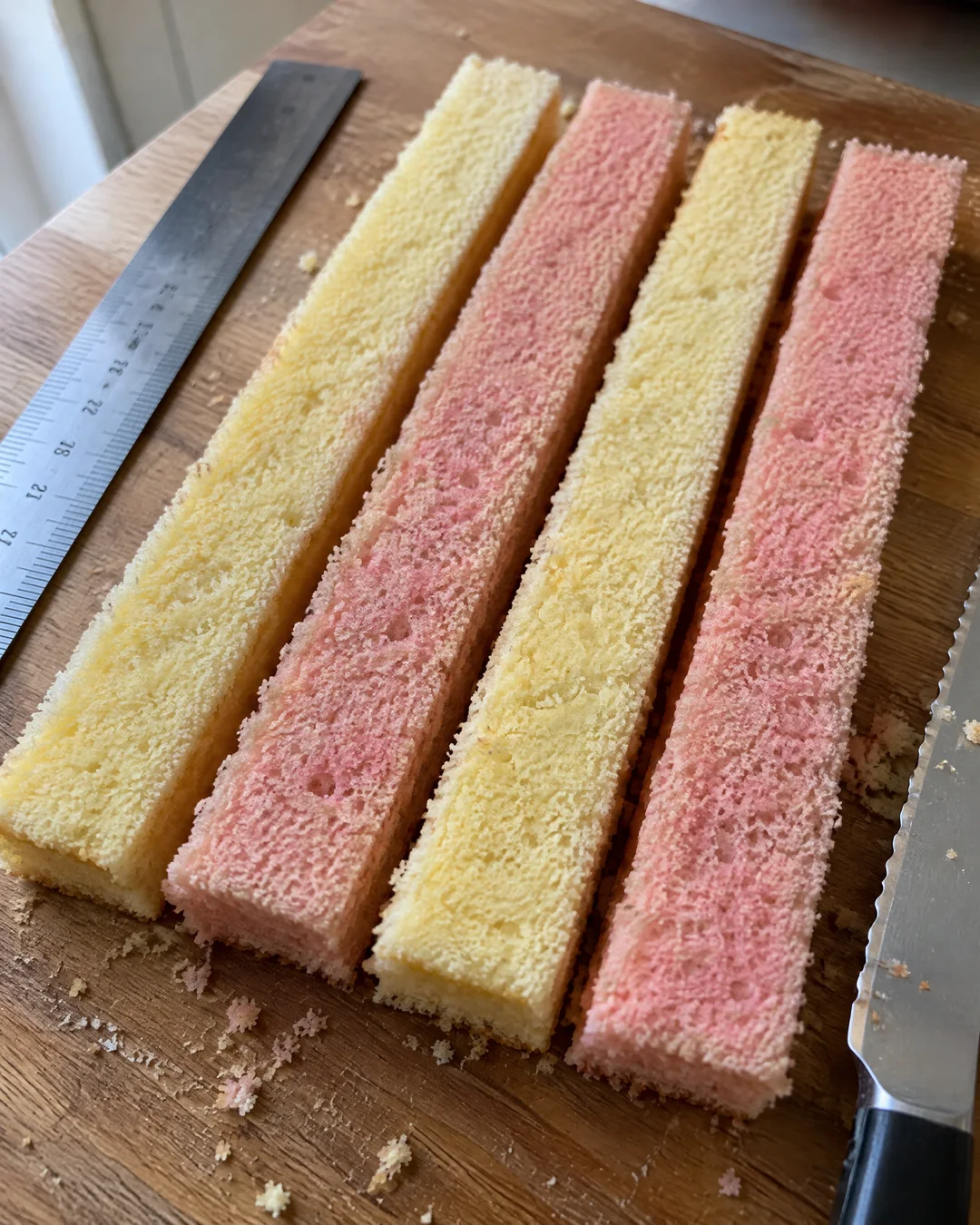
- Warm the apricot jam and press it through a sieve. Brush the long sides of the strips with jam and stick them together in a checkerboard: a pink beside a plain on the bottom, then a plain on top of the pink and a pink on top of the plain.
- Dust the counter with powdered sugar and roll the marzipan into a rectangle long enough to cover the cake and wide enough to wrap all the way around. Brush the outside of the cake with jam, set it on the marzipan and roll it up, pressing the seam closed underneath.
- Trim the ends to show the checkerboard, crimp the top edges with your fingers, sprinkle with a little sugar and let it set for an hour before slicing.
Tips that make the difference
- Use a ruler when you trim the sponges. Margaret does, and it is the only reason hers come out perfectly square.
- Add the coloring a drop at a time. You want a soft pink, not red.
- Chill the trimmed strips for 15 minutes before gluing. Cold sponge is firmer and easier to stack.
- Keep the seam of the marzipan underneath and slice with a sharp serrated knife.
Variations
- Chocolate Battenberg. Replace 2 tablespoons of flour in one half with cocoa powder for brown and yellow squares.
- Lemon. Use lemon zest instead of almond extract and lemon curd as the glue.
- Raspberry jam. Swap the apricot for sieved raspberry jam if you prefer a fruitier line.
- No marzipan. Wrap it in rolled fondant instead, or simply dust with powdered sugar and serve it as a checkerboard loaf.
Storage and make-ahead
Wrap the Battenberg in plastic wrap and keep it at room temperature for up to 4 days. The marzipan keeps the sponge moist.
Slice only what you need and wrap the cut end tightly so it does not dry out.
It freezes well, wrapped in plastic and foil, for up to 2 months. Thaw it in the wrapping.
Frequently asked questions
Why is it called Battenberg?
The story goes that it was created for the 1884 wedding of Prince Louis of Battenberg into Queen Victoria’s family, and that the four squares stood for the four Battenberg princes. Nobody can quite prove it, but every British baker tells it.
Do I need a special Battenberg pan?
No. An ordinary 8 inch square pan divided with a strip of folded foil works perfectly.
Can I make it without almonds?
You can leave out the ground almonds and use the same weight of flour, but the marzipan is made from almonds, so for a nut-free cake use fondant.
Why did my checkerboard come out crooked?
The strips were different sizes. Trim the tops and sides off both sponges and measure each strip before you glue them.
Measure, trim, glue and roll. Then cut the first slice in front of somebody and wait for them to ask how you got the squares inside.
Battenberg Cake (The British Checkerboard Cake in Marzipan)
Classic British Battenberg cake: one almond sponge baked in an 8 inch square pan divided in two, plain and pink, trimmed into four strips, glued in a checkerboard with apricot jam and wrapped in marzipan. Baked at 350 degrees for 25 to 30 minutes.
Ingredients
- 3/4 cup unsalted butter (175g), soft
- 3/4 cup plus 2 tablespoons superfine or granulated sugar
- 3 large eggs, at room temperature
- 1 1/4 cups all-purpose flour
- 1/3 cup ground almonds or almond flour
- 2 teaspoons baking powder
- 1/4 teaspoon fine salt
- 2 tablespoons whole milk
- 1/2 teaspoon almond extract
- 1/2 teaspoon vanilla extract
- A few drops of red or pink food coloring
- 1/2 cup apricot jam
- 8 ounces marzipan
- Powdered sugar, for rolling
- 1 teaspoon granulated sugar, for sprinkling
Instructions
- Heat the oven to 350 degrees (175°C). Grease an 8 inch square pan. Fold a long piece of foil into a strip about 2 inches high and set it down the middle of the pan to make two equal halves, then line both halves with parchment.
- Beat the butter and sugar together for 3 to 4 minutes, until pale and fluffy.
- Beat in the eggs one at a time, adding a spoonful of the flour with the last egg so the mixture does not curdle.
- Fold in the rest of the flour, the ground almonds, baking powder and salt, then the milk, almond extract and vanilla, until smooth.
- Weigh or measure the batter into two equal portions. Tint one portion pink with a few drops of coloring, stirring until even.
- Spoon the plain batter into one side of the pan and the pink into the other. Smooth both tops.
- Bake for 25 to 30 minutes, until risen, springy and a toothpick comes out clean. Cool 10 minutes in the pan, then lift out and cool completely on a rack.
- Trim the domed tops and the browned sides off both sponges. Cut each sponge in half lengthways so you have four long strips, two plain and two pink, all exactly the same width and height.
- Warm the apricot jam and press it through a sieve. Brush the long sides of the strips with jam and stick them together in a checkerboard: a pink beside a plain on the bottom, then a plain on top of the pink and a pink on top of the plain.
- Dust the counter with powdered sugar and roll the marzipan into a rectangle long enough to cover the cake and wide enough to wrap all the way around. Brush the outside of the cake with jam, set it on the marzipan and roll it up, pressing the seam closed underneath.
- Trim the ends to show the checkerboard, crimp the top edges with your fingers, sprinkle with a little sugar and let it set for an hour before slicing.